Results of the Internet questionnaire posted on the Medisport website :
Questionnaire on lactose intolerance©
Copyright 2001 © by
Philippe REUMONT - Registered Dietetitian
All rights reserved. No part of this page may be reproduced or utilized in any form or by any means, electronic or mechanical, including photocopying, recording, or by any information storage or retrieval systems, without permission in writing from the author. For information contact : philippe.reumont@medisport.be
Survey questions «Questionnaire on lactose intolérance© » available : http://www.medisport.be.
Many links concerning lactose intolerance are available on line.
Summary
Lactose intolerance affects more than 50 million Americans. It is one of the most common gastrointestinal disorders seen by primary care physicians. Lactose intolerance is commonly misdiagnosed because of its overlapping symptoms of diarrhea and abdominal bloating. When this disorder is properly diagnosed, the patient is easily treated with education and dietary.
Our study of the symptoms of lactose intolerance highlights a high percentage of diarrheas among diagnosed as lactose intolerant people. The symptoms are often felt by them either as a «discomfort»or as a «great discomfort»" in their everyday life.
The «classic» treatment often choosen by lactose intolerant people is a complete elimination of lactose in their diet. But this is not the best solution because it geopardizes the necessary daily intake of calcium. Moreover it is rather rare that someone has to totally eliminate milk or dairy products from his diet.
The reduction or the disappearance of the symptoms of lactose intolerance can be obtained by :
· The adoption either of a LACTOSE FREE DIET by diagnosed as intolerant
patients or by the adoption of a diet with LOW lactose intake by people
believing to be lactose intolerant ;
· The consumption of synthetic lactase. Our study as shown that this
product seems to have a great efficiency as regards the reduction of the
symptoms ;
· Improvement of dietetic awareness of lactose intolerant people.
Indeed, our study as shown that they absorb insufficient quantities of dairy
products and of substitutive dairy products (lactose free dairy products).
The degree of lactose tolerance varies from one person to another. Thanks to individual tolerance test, on one hand, and to appropriate dietetic guidelines, on the other hand, a pertinent solution to the problem can be found and should allow lactose intolerant people to live comfortably without symptoms nor deficiencies.
Introduction
1) Lactose intolerance
Lactose intolerance is due to the impossibility to digest significant quantities of lactose, the most important sugar of milk. This deficiency is the consequence of a shortage of the enzyme called lactase (lactase phlorizin hydrolase), which is normally produced by the cells that line the small intestine. Lactase deficiency leads to the maldigestion of lactose : the intestine is unable to hydrolize the totality of lactose into glucose and galactose. This leads to a malabsorption of lactose. The not digested lactose in the small intestine can cause the symptoms felt by the lactose intolerant people : cramps, distensions, gases or diarrhea. These symptoms generally appear from 30 minutes till 2 hours after lactose intake. The importance of the symptoms depends on the quantity of residual intestinal lactase, the quantity of lactose intake and the conditions of ingestion (for example: the lactose has been intake with or without other food). This explain why the symptoms can varie significantly from one person to another.
There are two types of deficiencies of lactase enzyme :
· the primary deficiency which is a permanent state. The congenital
form is very rare, while the delayed lactase disappearance, also called
primary hypolactasy of the adult, is much more common. The lactasic activity
generally starts to decline as from the ageof 2 ; however this phenomenon
can also appear only towards the age of 20
· secondary deficiency is generally a temporary state due to a deterioration of the mucous membrane of the small intestine. It lasts approximately one week after recovery. Young babies (infants) and children suffering from gastro-intestinal infection or malnutrition are particularly vulnerable to this type of secondary deficiency of lactase enzyme. It can also be caused by a coeliac disease, by an allergy to cow's milk, by certain drugs and by gastro-intestinal surgery (1).
2) Material and Methods
The aims of the study were :
· to define the symptoms described by people claiming they suffer from lactose intolerance and to try to establish if such symptoms were attenuated by the adoption of a specific diet.
· to explore dietetic knowledge of people claiming they are lactose intolerant and to determine if there are differences in the food habits between the people " believing to be lactose intolerant " and the " diagnosed as lactose intolerant people ".
This study aimed adult people (18 years old & older) and covered, in addition to potentially lactose intolerant people, health professionals such as : physicians, dieticians and nurses who could fill out the questionnaire for one of their patients.
The survey took place between December 15, 2000 and March 31, 2001 by means of a questionnaire published on an Internet site.
The questionnaire (available on line in 7 languages) was articulated as
follows :
· 8 medical questions ;
· 1 knowledge question concerning lactose content in foods ;
· 20 questions concerning life style and food habits.
For some questions a CHI-SQUARE statistical test(X2) has been applied. When the result is statistically significant, it is taken again accompanied by the threshold of significance.
Results
All participants answered themselves to the questionnaire. The characteristics of the participants are described in table 1.
| Table 1. Caractéristics of the participants | |
| Women | 60, i.e. 76 % of the sample |
| Men | 19, i.e. 24 % of the sample |
| Average age | 34 years |
| Average height | 1.67 meter |
| Average weight | 69 kg |
| Average BMI | 24.7 |
The guarantors were arbitrarily divided in 3 sub-groups :
Group 1: 39 people believing to be lactose intolerant
Group 2: 24 people diagnosed as lactose intolerant
Group 3: 16 people not belonging to the 2 above mentioned sub-groups.
Type of symptoms ? (when they are present)
The most frequent complaints are diarrheas (75 %) in the " diagnosed
as intolerant " sub-group and pains - cramps and flatulences (69,2 %)
in the " believing to be intolerant ".
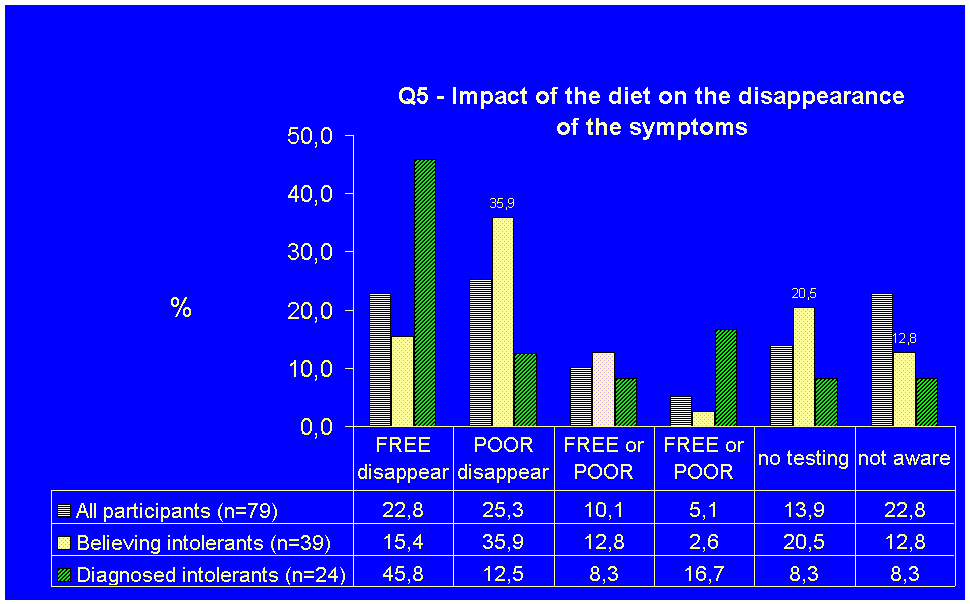
Impact of the DIET if you follow one
Lactose FREE diet :
· This diet seems to have the MOST SIGNIFICANT IMPACT on disappearance
of the symptoms (45,8 %) for the " diagnosed as intolerant " sub-group
· Lactose free diet SUPPRESSES THE SYMPTOMS in 3x more cases among
the " diagnosed as intolerant " sub-group (45,8%) (X2=10,409 p0,001)
than in the " believing to be intolerant " sub-group (15,4 %)
Diet with LOW intake (Poor) in lactose :
· A diet with a LOW intake in lactose SUPPRESSES THE SYMPTOMS in 3x
more cases in the " believing to be intolerant " sub-group (X2 =
4,561 p0,033) than in the " diagnosed as intolerant " sub-group
(12,5%) (X2 = 2,995 p0,084)
· A diet WITHOUT lactose or with LOW intake ATTENUATES the symptoms
in 1,5 X more cases in the " believing to be intolerant " sub-group
(12,8%) than in the " diagnosed as intolerant " sub-group (8,3 %)
· A diet WITHOUT lactose or POOR DOES NOT ATTENUATE the symptoms in
6,5X more cases in the " diagnosed as intolerant " sub-group (16,7
%) (X2 = 9,656) than in the " believing to be intolerant " sub-group
(2,6 %)
No special diet followed :
· The " believing to be intolerant " sub-group DID NOT TEST
ANY DIET in 2,5X more cases (20,5 %) (X2 = 2,790 p0,095) than the " diagnosed
as intolerant " sub-group (8,3 %)
· The " believing to be intolerant " sub-group DID NOT TEST
ANY DIET in 1,5X more cases (12,8 %) (X2 = 4,347 p0,037) than the " diagnosed
as intolerant " sub-group (8,3 %) (X2 = 4,092 p0,043) because they were
not aware of such diets
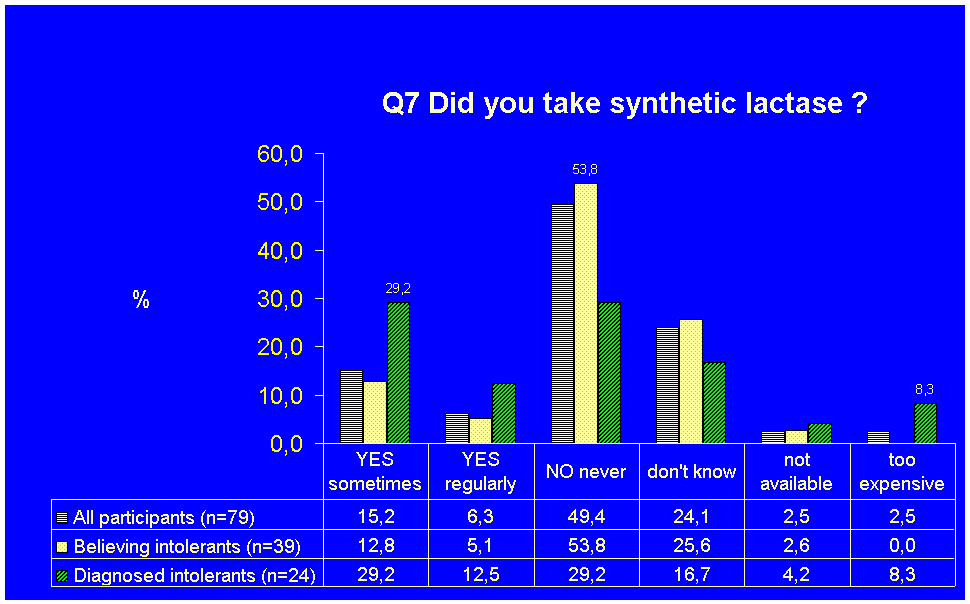
Did you take synthetic lactase ?
sometimes :
· 2,3X MORE persons in the " diagnosed as intolerant " sub-group
(29,2 %) (X2 = 5,227 p0,022) than in the " believing to be intolerant
" sub-group (12,8 %) SOMETIMES use lactase
regularly :
· 2,5X MORE persons in the " diagnosed as intolerant " sub-group
" (12,5 %) than in the " believing to be intolerant " sub-group
(5,1 %) REGULARLY use lactase
never :
· 1,8X MORE persons in the " believing to be intolerant "
sub-group (53,8 %) (X2 = 5,628 p0,018) than in the " diagnosed as intolerant
" sub-group (29,2 %) NEVER use lactase
· 1,5X MORE persons in the " believing to be intolerant "
sub-group (25,6 %) than in the " diagnosed as intolerant " sub-group
(16,7 %) DON'T KNOW LACTASE
· 8,3 % (X2 = 4,702 p0,030) persons in the " diagnosed as intolerant
" sub-group find this product TOO EXPENSIVE
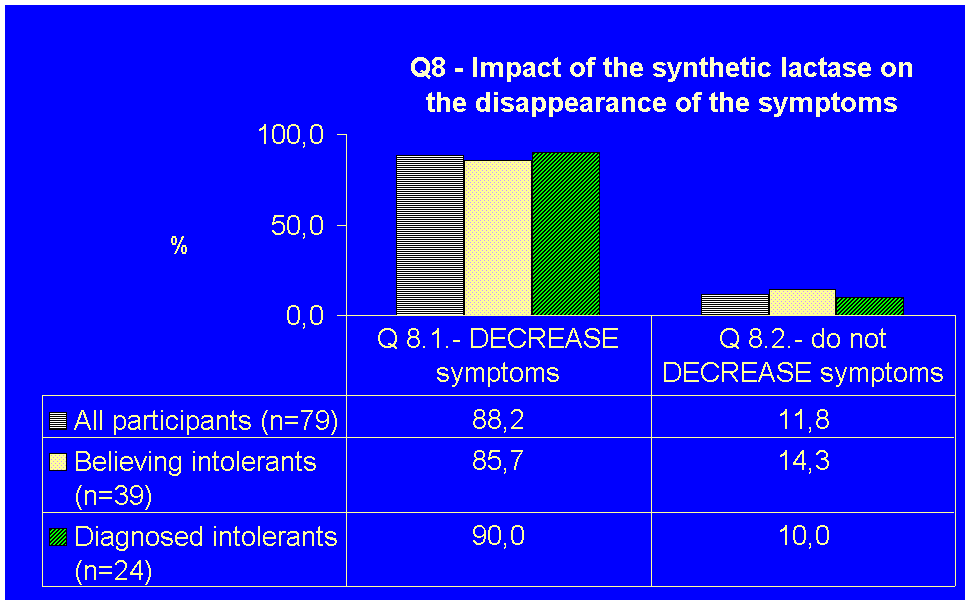
Impact of synthetic lactase if you tested it :
Synthetic lactase seems to decrease significantly the symptoms
of lactose intolerance "quite as much" in the " believing to
be intolerant " sub-group (85,7 %) as in the " diagnosed as intolerant
" sub-group (90 %).
In your opinion : can you find any lactose in following food ?
We have noticed a VERY BAD KNOWLEDGE in the 2 sub-groups (16
% of good answers) for pork-butcheries.
For other foods or industrial food products, there is a real lack of information
: croissants, biscuits (cookies) (57 %), eggs (58,2 %) and commercial mayonnaise,
dressings (59,5 %).
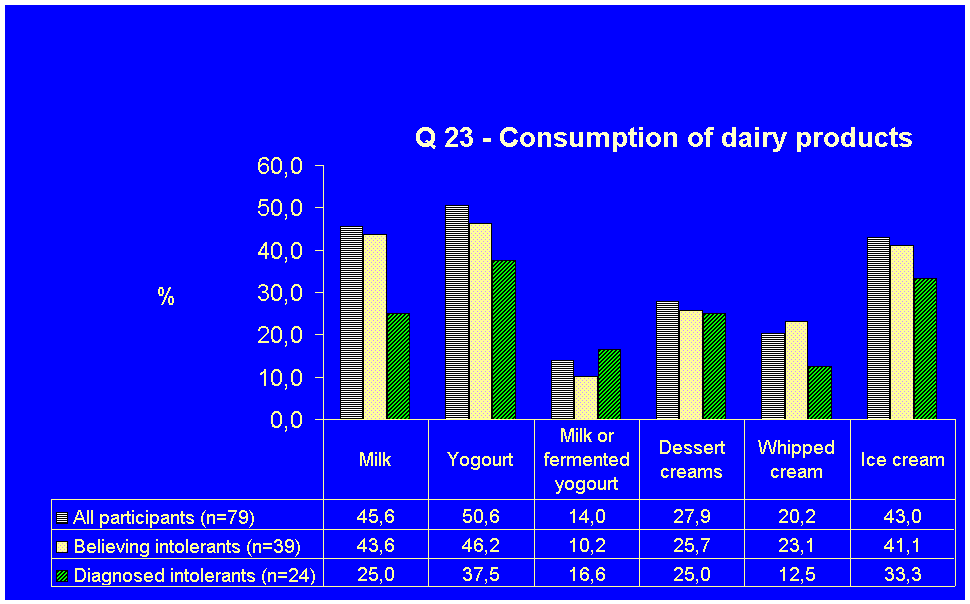
Do you consume following dairy products ?
· Persons in the " diagnosed as intolerant " sub-group consume
LESS milk, yoghourt, whipped cream and dairy ice cream than persons in the
" believing to be intolerant " sub-group
· Persons in the " diagnosed as intolerant " sub-group consume
MORE milk or fermentend yoghourt than persons in the " believing to be
intolerant " sub-group
· Persons in the " diagnosed as intolerant " sub-group consume
AS MUCH AS cream than persons in the " believing to be intolerant "
Do you consume lactose free products (substitute of the dairy products
) ?
The most consumed lactose free products are the soya milk, sorbets, soya desserts, milk lactose reduce and the soya yoghourt. Those products are consumed mainly by the diagnosed lactose intolerant persons. However it is important to notice that from 57 % to 76 % of the participants don't consume any lactose free products.
Do you consume following cheeses ?
Let us notice that FEW participants consume cheese (from 20 to 30 %).
Persons in the "diagnosed as intolerant " sub-group consume DEFINITELY
LESS Gouda, goat's cheese, fromage frais (soft white cheese) and cheese spread
than persons in the " believing to be intolerant " sub-group. Persons
in the " diagnosed as intolerant " sub-group consume MORE Gruyere,
Camembert cheese and Brie cheese than persons in the " believing to be
intolerant " sub-group.
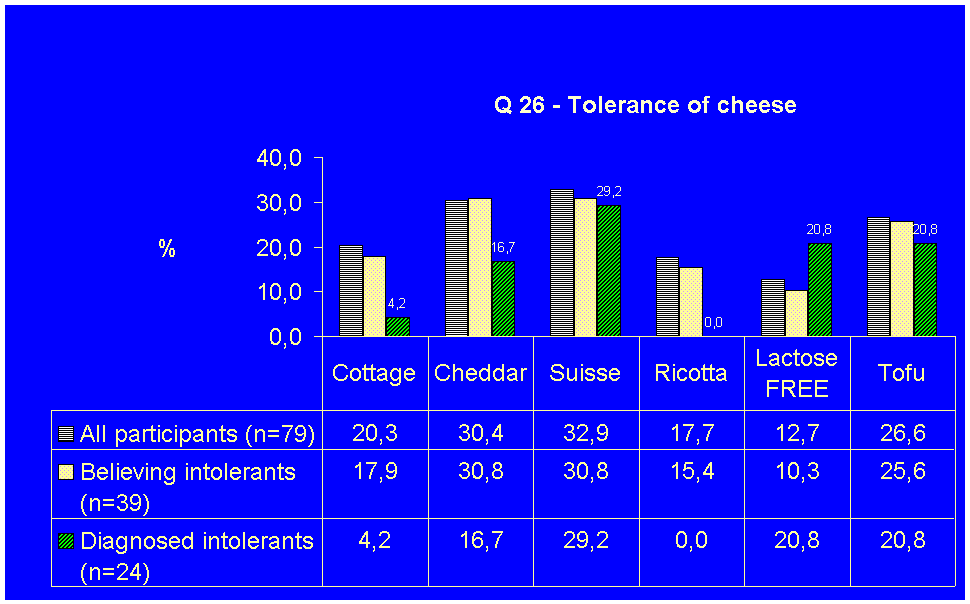
Do you tolerate following cheeses ?
Note: by Swiss cheese it is necessary to understand hard cheese : Gruyère
or Emmenthal cheese.
· Persons in the " diagnosed as intolerant " sub-group tolerate
DEFINITELY LESS the Cottage cheese than the Cheddar cheese
· Persons in the " diagnosed as intolerant " sub-group tolerate
the Swiss cheese AS MUCH AS persons in the " believing to be intolerant
" sub-group
· Persons in the " diagnosed as intolerant " sub-group don't
tolerate the Riccota cheese whereas persons in the " believing to be
intolerant " sub-group consume some and tolerate the Riccota cheese
· Persons in the " diagnosed as intolerant " sub-group tolerate
DEFINITELY MORE cheese without any lactose than persons in the " believing
to be intolerant " sub-group
Discussion
As well as a clinical point of view as a dietetic point of view, this study tried to show relevant differences between persons in " diagnosed as intolerant " and persons " believing to be intolerant ".
Those two aspects are synthesized with through on the one hand symptoms and on the other hand dietetic knowledge and diet habits.
The study of the symptoms of our 2 sub-groups highlights :
· the strong percentage (75 %) of diarrheas found in the " diagnosed
as intolerant " sub-group shows that for main persons in the " diagnosed
as intolerant " sub-group the problem is serious and not under control.
Moreover for 60 % of the persons concerned, symptoms are felt like "
discomfort " or " great discomfort " in their everyday life.
The obtained results are in adequacy with the literature (1) (2) (3) (4) :
diarrheas, pains - cramps and flatulences.
· Symptoms are felt like " more discomfortable " by persons in the " diagnosed as intolerant " sub-group since the symptoms are felt like " rather discomfortable " by 54,2 % of persons in the "diagnosed as intolerant " sub-group and by 48,7 % of persons in the " believing to be intolerant " sub-group. The symptoms are felt as " very discomfortable " in 2x more cases in the " diagnosed as intolerant " sub-group (25 %) than in the " believing to be intolerant " sub-group (12,2 %)
· synthetic lactase seems to have a very good efficiency considering the reduction of lactose intolerance symptoms. These high percentages of symptoms reduction is very similar in the 2 sub-groups (85,7 % and 90 %), whatever the sub-groups of participants. These results have to be confirmed in a future survey. Despite, from now it seems interesting to sensitize persons "diagnosed as intolerant " and moreover persons " believing to be intolerant " to test the benefit of the synthetic lactase. Moreover since the use of this product seems not very widespread.
The study of the dietetic knowledge and the diet habits of our 2 sub-groups highlights :
· In the " diagnosed as intolerant " sub-group : the LACTOSE
FREE DIET seems to have the MOST SIGNIFICANT IMPACT on symptoms disappearance.
This observation is still reinforced by the fact that in this sub-group the
symptoms are not attenuated by a diet with a LOW lactose intake.
· In the " believing to be intolerant " sub-group this is
the LOW lactose intake which has the BETTER impact on symptoms disappearance
· The " believing to be intolerant " sub-group did not test
such diets definitely more often than the " diagnosed as intolerant "
sub-group. In the same way, the " believing to be intolerant " did
not test lactose free diets because they were not aware of such diets more
often than "diagnosed as intolerant " sub-group. This considerable
proportion (1/5) which does not know these adapted diets (and which probably
would have tested them if they had known them) illustrates the work which
it remains to make, as well sensitizing as of popularization of these lactose
free diets or low lactose intake diet.
· Synthetic lactase is mainly consume by " diagnosed as intolerant
" sub-group. A promotion (as well in the " diagnosed as intolerant
" sub-group as in the " believing to be intolerant " sub-group
) for an improvement of the use of this product should be necessary, according
to the great efficiency of this product.
· the 2 sub-groups have a VERY GOOD knowledge of the lactose content for milk. For prepared dishes : the knowledge is VERY GOOD in the " diagnosed as intolerant " sub-group and GOOD in the " believing to be intolerant " sub-group. On the other hand for pork-butcheries : the knowledge is VERY BAD in the 2 sub-groups. Within the framework of a nutritional education it should be necessary to insist on this food products or preparated food products. These figures are the witnesses of the ignorance of the participants. This lead us to insist on the importance of an adapted nutritional information.
· It would be advisable to sensitize " diagnosed as intolerant " as " believing to be intolerant " those persons witch kind of dairy products, substitute for dairy products and cheeses they are able to digest. The objective is : to try to reach a sufficient daily calcium intake, without or with the appearance of few symptoms.
· Mention that " diagnosed as intolerant " tolerate tofu
AS MUCH AS lactose free cheese.
Broadly in the 2 sub-groups tolerance is good for : Swiss cheese, lactose
free cheese
and for tofu whereas tolerance is average for Cheddar cheese
Consequences and nutritional recommendations applicable to lactose intolerant adults :
Medical & Nutritional facts (guidelines) :
· the case of each lactose intolerant person is different. There is
probably as much lactose intolerance as lactose intolerant individuals. The
only way of knowing the lactose tolerance degree of an individual is to carry
out tests. It is rather rare that someone has to totally eliminate milk or
dairy product from his diet (5).
· It is necessary always to keep in mind that the dairy products are
our principal source of calcium (6) (7).
· In addition, it was proven that the gradual increase consumption
of lactose containing foods, increases the lactose tolerance among intolerant
persons (1) (3) (4).
· Use of synthetic lactase should be promote, according to the great efficiency of this product (as well in " diagnosed as intolerant " sub-group as in the " believing to be intolerant " sub-group).
· Improvement of dietetic awareness of lactose intolerant people. Indeed, our study as shown that they absorb insufficient quantities of dairy products and of substitutive dairy products. Appropriate dietetic guidelines, is a pertinent solution to the problem and should allow lactose intolerant people to live without symptoms nor deficiencies.
Three ways can be followed by lactose intolerant people to manage to reach
the daily recommended calcium intake (8) :
· to continue to absorb dairy products and this, to a lesser extent
by managing the food choice in order to reduce the symptoms (4)
· to explore food sources to find other sources of calcium (vegetables,
fish and shellfish, substitute products, cheeses (lactose free cheese, tofu
or hard cheeses), breads and flours (enriched with calcium - for example in
the United Kingdom and in the USA), mineral water (9)
· to take calcium tablets (10)
silverings drugs have a negative effect on the activi
Conclusion:
We would conclude by mention the great interest of lactose intolerant people
to find useful information. In the field of lactose intolerance it seems possible
to share informations and resources with the " peers " and contribute
to improve the knowledge and the management of the symptoms. A future survey
especially devoted to precise the use and the impact of the synthetic lactase
could be interesting and should be very useful. Also, we would be very happy
if this article could suggest interest in this direction to the scientific
community.
All rights reserved. No part of this page may be reproduced or utilized in any form or by any means, electronic or mechanical, including photocopying, recording, or by any information storage or retrieval systems, without permission in writing from the author. For information contact : philippe.reumont@medisport.be
Survey questions «Questionnaire on lactose intolérance© » available : http://www.medisport.be.
Many links concerning lactose intolerance are available on line.
For any additional information:
Philippe Reumont
Registered dietitian
Philippe.reumont@medisport.be
Bibliography
1. http://www.niddk.nih.gov/health/digest/pubs/lactose/lactose.htm
NIDDK- National Digestive Diseases Information Clearringhouse.
2 . Steve Carper " Milk is not for every body ", 1995, Facts On
File,
New York, pages 190-204, ISBN 0-8160-3127-4.
3. http://ificinfo.health.org/insight/fi1112c.htm
IFIC - A definition of lactose intolerance and advice on how to lower
lactose while retaining calcium in the diet
4. http://www.nationaldairycouncil.org/medcent/calcium/htmls/cal12.html
5. http://www.dietetistes.ca./eatwell/francais/factsheets/f1997-10.html
6. M. Apfelbaum, C. Forrat, P. Nillus " Diététique et nutrition
", 1997, Masson, Paris,
page 313
7. Steve Carper " Milk is not for every body ", 1995, Facts On File,
New York, pages 55-64, ISBN 0-8160-3127-4.
8. Steve Carper " Milk is not for every body ", 1995, Facts On File,
New York, page 56, ISBN 0-8160-3127-4.
9. Steve Carper " Milk is not for every body ", 1995, Facts On File,
New York, page 55, ISBN 0-8160-3127-4.
10. Steve Carper " Milk is not for every body ", 1995, Facts On
File,
New York, page 57-62, ISBN 0-8160-3127-4.
11. M. Apfelbaum, C. Forrat, P. Nillus " Diététique et
nutrition ", 1997, Masson, Paris,
page 104
12. M. Apfelbaum, C. Forrat, P. Nillus " Diététique et
nutrition ", 1997, Masson, Paris,
pages 103-105
13. Steve Carper " Milk is not for every body ", 1995, Facts On
File,
New York, pages 81-99, ISBN 0-8160-3127-4.
Google maps
Consultations :
avenue du Derby 59 - 1050 Bruxelles
(Ixelles)
Tél +32 (0) 475 732 983
trams 8 et 25 - bus 41 arrêt Brésil - train gare Boondael
philippe.reumont[@]gmail.com